
Table of Contents
- Introduction: The Complexities of Sourcing “Cheap” Cotton Yarn in China
- Current Market Landscape: An In-Depth Price & Supply Analysis (2025-2026)
2.1 Navigating the “Internal Volume”: Understanding Regional Price Wars
2.2 National Price Benchmark: Key Product Categories and Specifications - The Geographical Advantage: Profiling China’s Major Cotton Yarn Production Hubs
3.1 Xinjiang: The Price Disruptor and Scale Leader
3.2 Shandong & Jiangsu: The Traditional Powerhouses
3.3 Other Notable Regions: Anhui, Henan, and Zhejiang - Beyond the Price Tag: Key Factors Impacting Total Landed Cost and Value
4.1 Quality Spectrum: From Low-Grade to Combed and High-Count Yarns
4.2 Spinning Technology: OE vs. Ring-Spun and Its Implications
4.3 Logistics, Trade Terms, and Hidden Costs - Strategic Sourcing Channels: From B2B Platforms to Direct Factory Engagement
5.1 Pros and Cons of Major Online Marketplaces
5.2 Working with Trading Companies vs. Direct Factory Sourcing
5.3 The Role of Industry Hubs and Trade Fairs - Price Forecast and Strategic Procurement Advice (2026-2027)
- FAQ: Your Questions Answered
1. Introduction: The Complexities of Sourcing “Cheap” Cotton Yarn in China
For global procurement managers, the quest for “cheap” Chinese pure cotton yarn is both a significant opportunity and a potential minefield. In 2025, China’s total yarn capacity reached a staggering 116.3 million spindles. However, Where to Find Inexpensive Pure Cotton Yarn in China this massive supply coexists with subdued downstream demand in apparel and home textiles, creating a fiercely competitive, buyer-favorable market where prices have been in a sustained downward channel.
The term “cheap,” however, is multifaceted. The lowest quoted price does not always equate to the lowest total cost or the best value for your specific application. Factors such as regional production advantages, yarn quality (low-grade vs. combed), spinning method (open-end vs. ring-spun), logistical efficiency, and supplier reliability are critical determinants of your final landed cost and production outcome.
This guide moves beyond simple price lists to provide a holistic, strategic framework for sourcing. We will dissect the current market dynamics, analyze regional cost drivers, and equip you with the knowledge to make informed, cost-effective procurement decisions that safeguard both your budget and your product quality.
2. Current Market Landscape: An In-Depth Price & Supply Analysis (2025-2026)
2.1 Navigating the “Internal Volume”: Understanding Regional Price Wars
A dominant theme in today’s market is the intense “internal volume,” where excess capacity in one region depresses prices nationwide. The most significant force in this dynamic is Xinjiang. Bolstered by local policy support and raw cotton access, Xinjiang’s yarn capacity has surged, flooding the domestic market with competitively priced yarn and putting immense pressure on mills in traditional coastal hubs. This internal competition is a primary reason why many yarn mills are currently operating at a loss.
2.2 National Price Benchmark: Key Product Categories and Specifications
While prices are negotiable and volatile, recent market data provides a clear benchmark. The table below synthesizes spot transaction prices from major Chinese textile markets for mid-to-late January 2026.
Table 1: Pure Cotton Yarn Price Benchmarks (January 2026) – Transaction Prices (RMB/Ton)
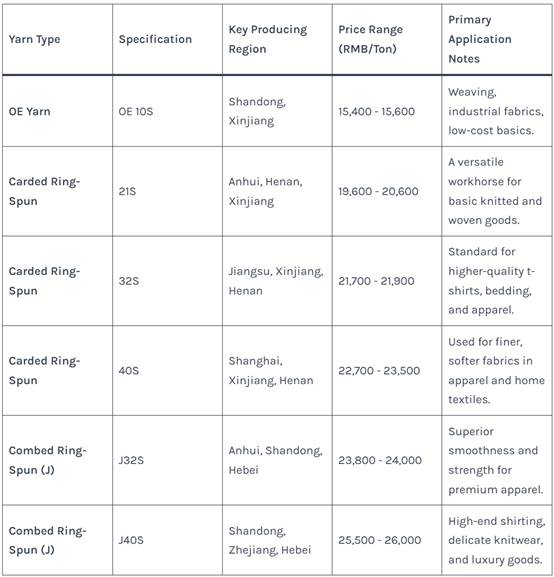
Note: ‘J’ denotes Combed Yarn. OE = Open-End (Rotor) Spun. Prices are for white, first-grade yarn, excluding VAT. Source: Compiled from Sinotex market reports.
A clear price hierarchy is evident: Open-End (OE) yarns are the most economical, followed by carded ring-spun, with combed (J) ring-spun commanding a significant premium due to the additional refining process that removes short fibers and impurities.
3. The Geographical Advantage: Profiling China’s Major Cotton Yarn Production Hubs
3.1 Xinjiang: The Price Disruptor and Scale Leader
Xinjiang is currently the epicenter of “cheap” yarn in China. Its advantages are structural:
- Raw Material Proximity: As China’s largest cotton-growing region, mills save substantially on raw material transportation.
- Policy & Energy Incentives: Government subsidies and lower energy costs contribute to reduced production overhead.
- Modern, Large-Scale Mills: Newer facilities benefit from economies of scale.
- Considerations: While price is compelling, international buyers must conduct thorough due diligence on logistics from this inland region and be aware of any supply chain compliance requirements related to the region.
3.2 Shandong & Jiangsu: The Traditional Powerhouses
These eastern coastal provinces remain the bedrock of China’s textile industry, offering a different value proposition.
- Shandong: A massive and diverse producer, from basic OE yarns to high-end combed yarns. Suppliers like Weifang Jinghe Textile exemplify the region’s focus on versatile product ranges, including specialized yarns like slub yarn . It offers a balance of cost-competitiveness and accessibility for export.
- Jiangsu: Home to the GLYarn market—a crucial national price-setting hub. Mills here are often highly integrated, with strong technical expertise in finer counts and blended yarns. Logistics for international shipping are typically excellent due to proximity to major ports like Shanghai.
3.3 Other Notable Regions: Anhui, Henan, and Zhejiang
- Anhui & Henan: Major contributors to the mid-range carded yarn market (e.g., 21S, 32S), often competing directly with Xinjiang on price for these specifications.
- Zhejiang: A hub for innovation and blended yarns, with a strong presence in regenerated and recycled cotton-polyester blends aimed at the eco-conscious market.
4. Beyond the Price Tag: Key Factors Impacting Total Landed Cost and Value
4.1 Quality Spectrum: From Low-Grade to Combed and High-Count Yarns
The specification is paramount. A “21S” yarn from different mills can vary drastically. Key quality differentiators include:
- Fiber Origin & Grade: Domestic cotton vs. imported (e.g., U.S., Australian). Longer staple lengths cost more.
- “Low-Configuration” Yarns: Some attractively priced yarns may use a lower percentage of longer-staple cotton or more short fibers, affecting evenness and strength.
- Combed vs. Carded: Combed yarns (J21S, J32S) are cleaner, stronger, and more lustrous, justifying a 15-20% price premium over their carded equivalents.
4.2 Spinning Technology: OE vs. Ring-Spun and Its Implications
The choice between Open-End (OE) and Ring-Spun technology is a major cost and quality decision.
- Open-End (OE) Yarn: The most cost-effective method. Yarn is less strong and less even but has better coverage. Ideal for denim, canvas, heavy knits, and fabrics where a rougher hand-feel is acceptable.
- Ring-Spun Yarn: The traditional method producing stronger, smoother, and more durable yarn. Essential for fine knits, high-thread-count wovens, and fabrics requiring a soft hand. Commands a higher price.
4.3 Logistics, Trade Terms, and Hidden Costs
The FOB price is just the beginning. To calculate true landed cost, consider:
- Inland Freight: Shipping from Xinjiang to a coastal port adds cost and time versus shipping from Shandong or Jiangsu.
- Minimum Order Quantity (MOQ): Factories offer better per-unit prices for container loads (usually 20-25 tons). Trading companies or platforms like Alibaba may offer lower MOQs but at a higher unit cost.
- Payment Terms: Secure terms (e.g., LC) may involve slightly higher costs than risky TT-in-advance terms.
- Quality Consistency: The cost of a production batch failure due to inconsistent yarn far outweighs a small initial price saving.
5. Strategic Sourcing Channels: From B2B Platforms to Direct Factory Engagement
5.1 Pros and Cons of Major Online Marketplaces
- Alibaba.com: Excellent for discovering new suppliers, comparing prices, and placing sample orders. Ideal for small to medium batch sizes. Vigilance is required to verify factory authenticity and quality control capabilities.
- Made-in-China.com: Similar to Alibaba, with a strong base of manufacturing-focused suppliers, including specialized mills like Weifang Jinghe Textile.
- Yiwugo.com: Represents the massive Yiwu wholesale market. Suppliers here, like Yiwu Hengna Textile, are often trading companies or smaller workshops ideal for spot purchases, mixed batches, and DIY/craft-level yarns.
5.2 Working with Trading Companies vs. Direct Factory Sourcing
- Trading Companies: Provide convenience, consolidation, lower MOQs, and quality inspection services. They add a margin but can simplify logistics and communication for new buyers.
- Direct Factory Sourcing: Offers the best possible price for large, consistent orders. Requires more due diligence, stronger technical communication, and often involves higher MOQs. Visits to factories and trade fairs (like the China International Textile Yarns & Fabrics Show) are invaluable for building direct relationships.
6. Price Forecast and Strategic Procurement Advice (2026-2027)
Market analysts project that the current phase of aggressive capacity expansion will slow through 2026-2030. While the fundamental oversupply may gradually ease, the buyer’s market is expected to persist in the near term.
Strategic Procurement Recommendations:
- Decode the Specification: Never negotiate on “21S yarn” alone. Specify: Combed or Carded? OE or Ring-Spun? Required strength and evenness metrics? Request and test physical samples.
- Target the Right Region: For bulk, standard carded yarns (21S-40S), engage with suppliers in Xinjiang, Shandong, and Anhui for the most competitive quotes. For higher-end combed yarns or complex blends, focus on Jiangsu, Shandong, and Zhejiang.
- Calculate Landed Cost: Build a spreadsheet that includes FOB price, inland freight, international shipping, insurance, and import duties to compare offers accurately.
- Prioritize Reliability: For long-term production planning, a slightly higher-priced but dependable supplier with consistent quality is far more valuable than the cheapest, most unpredictable option.
- Consider Forward Contracts: In a market where prices are low but potentially stabilizing, discuss fixed-price contracts for 6-12 months with trusted suppliers to lock in favorable rates and guarantee supply.
7. FAQ: Your Questions Answered
Q1: Which region in China currently offers the absolute lowest FOB price for standard carded pure cotton yarn?
A: Based on current market dynamics, Xinjiang typically offers the most competitive FOB prices for bulk orders of standard carded yarns (e.g., 21S, 32S) due to its integrated supply chain and scale. However, always compare the final landed cost including logistics.
Q2: What is the typical price difference between carded and combed yarn of the same count?
A: For a count like 32S, combed yarn (J32S) commands a premium of approximately 8-12% over carded 32S, based on recent market data. This premium pays for superior smoothness, strength, and reduced pilling.
Q3: I need small batches for sampling and initial production runs. Where should I look?
A: Online B2B platforms like Alibaba.com or wholesalers on Yiwugo.com are best suited for lower MOQs. Be prepared for a higher per-unit cost compared to full container load prices.
Q4: Are the prices on B2B websites like Alibaba realistic for large orders?
A: The listed prices are often starting points or for small quantities. For container load (20-25 ton) inquiries, you must contact the supplier directly for negotiation. The final price will depend on your specifications, order volume, and payment terms.
Q5: How can I verify the quality of yarn from a new supplier before placing a large order?
A: 1) Insist on physical samples of the exact batch you intend to order. 2) Use a third-party inspection service (like SGS, Bureau Veritas) to conduct pre-shipment testing for key metrics (count, strength, evenness, composition). 3) Start with a trial order before committing to a large contract.
Q6: What are “low-configuration” or “low-grade” yarns mentioned in market reports?
A: These are yarns produced with a higher proportion of shorter-staple or lower-grade cotton to reduce cost. They may be suitable for some applications (like heavy weaves or felting) but can lead to more breaks in high-speed knitting/weaving and a inferior hand-feel in the final fabric.
Q7: Is it better to source from a factory or a trading company?
A: It depends on your scale and expertise. Large buyers (>5 containers/month) with technical staff benefit from direct factory sourcing for maximum cost control. Smaller or newer importers often benefit from the services, flexibility, and lower risk provided by a reputable trading company.
